
Summary
- Criminals claiming to be with the Internal Revenue Service (IRS) are targeting people with emails and text messages. Scammers are claiming U.S. taxpayers are eligible for an Economic Impact Payment (EIP). However, it is a scam. The ITRC began to see EIP payment scams during the COVID-19 pandemic.
- As part of the EIP payment scam, identity criminals send messages claiming you can receive an EIP payment. They say the IRS is sending payments to qualified individuals.
- However, messages like these are IRS scams seeking your personal and financial information to commit identity theft and fraud.
- The IRS will never email, text, call or send a message on social media to anyone. If you receive a message claiming to be from the IRS, ignore it. Forward it to the IRS at [email protected]. Note that it seems to be a phishing scam seeking your personal information.
- To learn more, or if you believe you have received IRS scams by email or text message, contact the ITRC toll-free by text or phone (888.400.5530) or live chat at idtheftcenter.org to speak with an expert advisor.
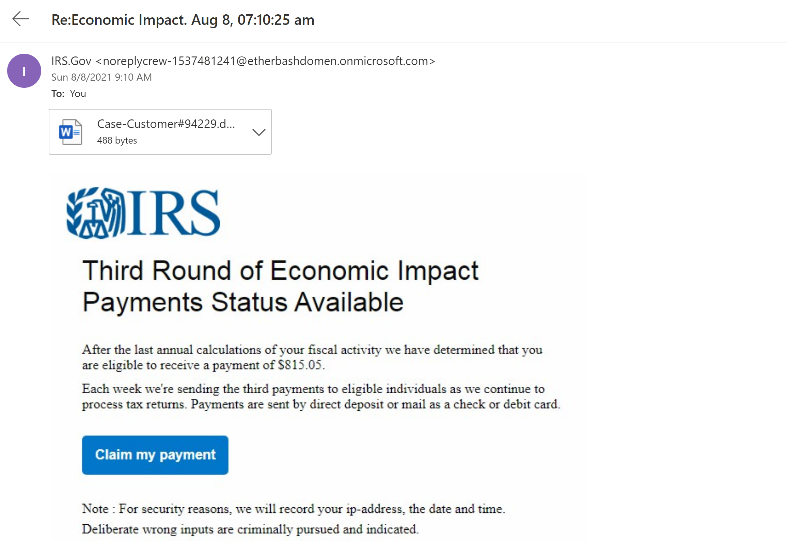
The Identity Theft Resource Center (ITRC) began to see Economic Impact Payment (EIP) scams by email and text during the COVID-19 pandemic when EIP payments were authorized as part of the American Rescue Plan Act. The Center has received messages about IRS scams by email, like the one below.

Now, the ITRC is getting reports of EIP payment scams where people receive text messages claiming they are eligible for a payment if they provide their personal information to a bogus website.

People should beware of scams asking for payment to receive compensation, and remember that the IRS will never call, message or email anyone.
Who are the Targets?
U.S. Taxpayers
What is the Scam?
In the latest IRS scams by email and text message, identity criminals send emails and texts to inboxes and phone numbers, claiming people are eligible to receive a payment. Many of the EIP payment scams say that each week, the IRS will continue to send EIP payments to eligible individuals as they process tax returns. The phishing emails also include a button to “claim my payment.” A handful of text messages ask you to reply, exit the text message, open it again, click the link or copy it into your Safari browser and open it.
What They Want
Scammers want you to either respond or click on a malicious link so they can steal your personal and financial information to commit different forms of identity crimes, including financial identity theft.
How to Avoid Being Scammed
- Ignore emails, texts or social media messages claiming to be from the IRS. Do not respond to the messages or click on any links or attachments because they could be malicious. Acting on the IRS scams by email, text or social media could lead to having your information stolen. The IRS will not email or message anyone. Do not share any personal information, including credit card and bank account numbers, except on the official www.IRS.gov website or the representative you contacted by calling the IRS.
- Ignore calls claiming to be from the IRS. While IRS scams by email and text continue circulating, identity criminals could call you, too. If you receive an unsolicited call claiming to be from the IRS, ignore it. The IRS will not call anyone unsolicited, either.
- Send phishing emails to the IRS. The IRS asks anyone who receives a phony email to forward it to [email protected] and note that it seems to be a phishing scam seeking your information.
- Report the identity crime. You can report identity fraud to the Federal Trade Commission (FTC) by visiting www.IdentityTheft.gov.
Contact the ITRC
If you have received IRS scams by email, text message, social media, phone, or any other form of EIP payment scam, you can also contact the ITRC toll-free by calling or texting 888.400.5530 or using the live chat function at www.idtheftcenter.org. ITRC expert advisors will help you create a resolution plan with the steps you need to take.
This scam alert was published on 10/28/21 and was updated on 1/24/25