
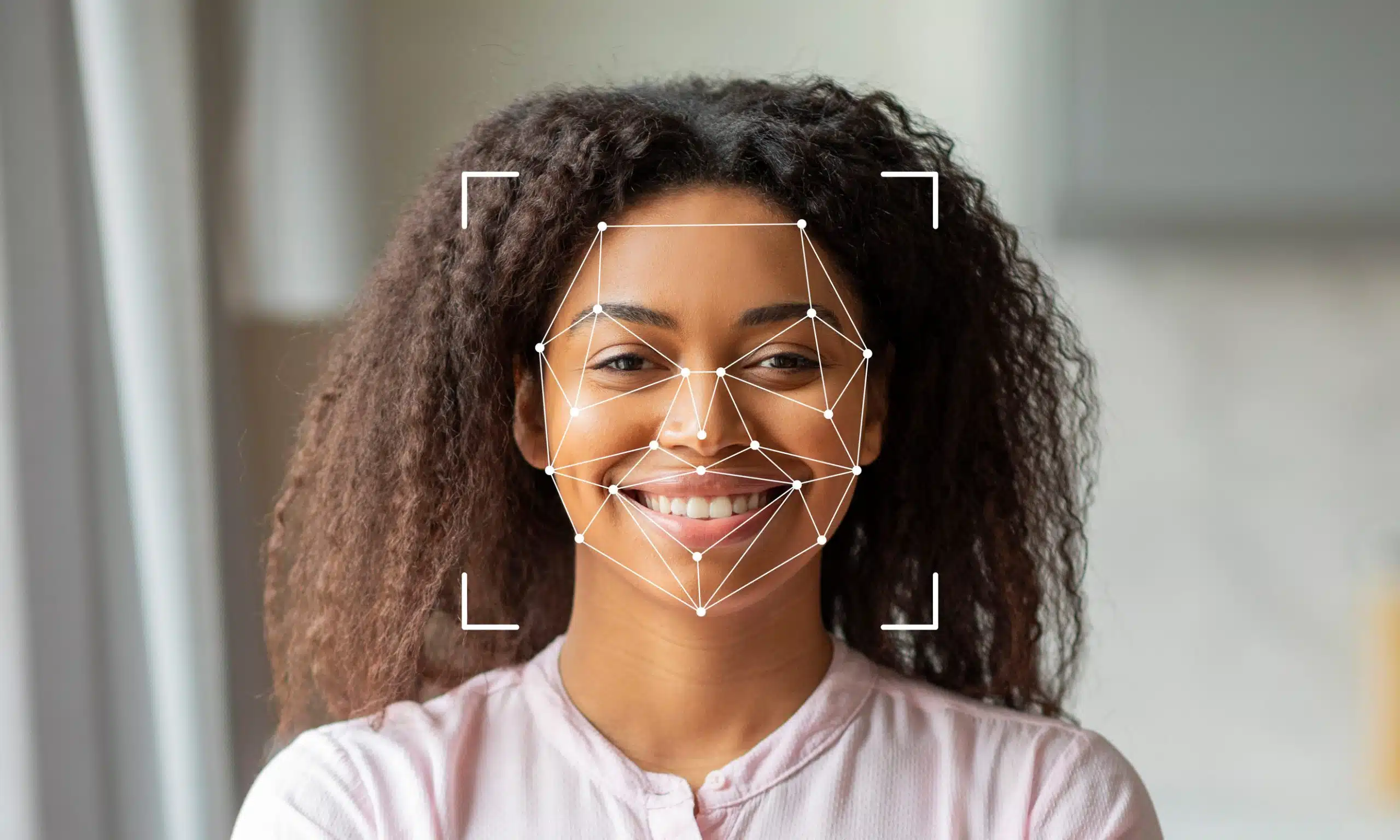
Key Summary
- Facial verification and facial recognition are two types of facial biometric technologies, but they serve different purposes.
- Facial verification confirms that a person is who they claim to be by comparing a selfie to an existing photo, such as a government ID.
- Facial recognition attempts to identify a person by comparing their face against a large database of images.
- Facial verification is commonly used for identity verification and fraud prevention, while facial recognition is often used for surveillance or locating individuals.
- Understanding the difference helps consumers make informed decisions about privacy, security and identity protection.
- If your identity is misused or compromised through digital verification systems, the Identity Theft Resource Center (ITRC) offers free support to help you recover.
Facial biometrics have become increasingly common in the digital world. We use our face and fingers to open our phones and other devices. Some companies use voice recognition to verify account access. Banks, online services, and government agencies often rely on facial technology to confirm a person’s identity during account creation, login processes, or financial transactions.
While the terms facial verification and facial recognition are sometimes used interchangeably, they represent two distinct technologies with different goals and privacy implications.
Understanding the difference between these systems is important for anyone concerned about identity theft, data privacy, or digital security.
Both technologies rely on artificial intelligence and biometric data, but they function in different ways and are used in different contexts.
What Is Facial Verification?
Facial verification is a biometric authentication process used to confirm that a person is who they claim to be by comparing two images of the same person. Traditionally, we have verified a person’s identity by using tools that use personal information. After two decades of data breaches, though, the personal information of virtually all adults has been exposed, rendering it less useful for proving someone’s identity to prevent fraud.
Today, organizations use biometrics to compare a real-time photo or video taken from a smartphone or webcam with a previously verified image, such as a passport photo, driver’s license photo, or other trusted identity document.The goal of facial verification is to answer a single question:
Is this person the same person shown in the verified identity document?
Because it compares only two images, facial verification is often referred to as a one-to-one comparison.
How Facial Verification Works
Most facial verification systems follow a similar process:
- A user uploads or scans an identity document such as a driver’s license or passport.
- The system captures a live selfie or short video from the user’s device.
- Artificial intelligence analyzes facial features and measurements in both images.
- The system determines whether the faces match within an acceptable confidence threshold.
Many systems also include “liveness detection,” which helps confirm that the person is physically present rather than using a photo or recording.
Common Uses Of Facial Verification
Facial verification is commonly used for:
- Opening bank or financial accounts online
- Verifying identity for government services
- Securing digital wallets and financial platforms
- Preventing fraud during account registration
- Confirming identity for remote onboarding processes
Because it confirms a person’s identity against a known reference, facial verification can help organizations reduce identity fraud and impersonation. It is also considered to be more privacy sensitive since you are aware your face is being used with your permission as part of a transaction you requested.
What Is Facial Recognition?
Facial recognition is a different type of biometric technology used to identify a person from a large pool of images.
Instead of confirming a person’s identity based on a known document, facial recognition attempts to determine who someone is by comparing their face against many images stored in a database.
This process is often referred to as a one-to-many comparison.
How Facial Recognition Works
In a facial recognition system:
- An image or video captures a person’s face.
- The system converts facial features into a biometric template.
- That template is compared against a database containing many facial images.
- The system attempts to identify a match from the database.
If a match is found, the system identifies the individual associated with the matching record.
Common Uses Of Facial Recognition
Facial recognition is commonly used for:
- Law enforcement investigations
- Surveillance or public safety monitoring
- Identifying individuals in large crowds
- Unlocking smartphones or devices in some cases
Because facial recognition searches across large datasets, it raises different privacy concerns than facial verification. Unlike facial verification, which you are aware is being used, facial recognition is done without your consent or awareness.
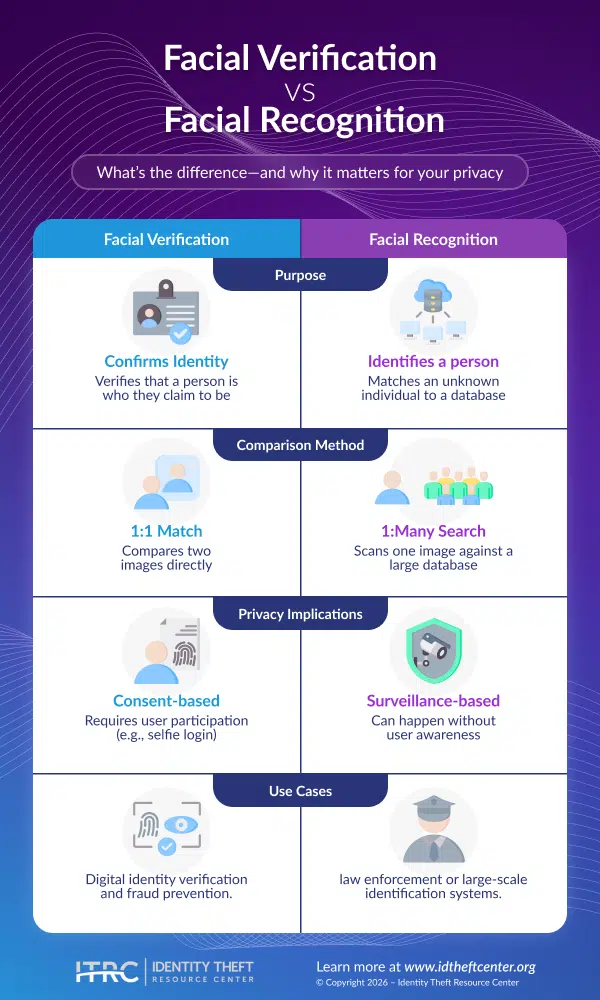
Key Differences Between Facial Verification And Facial Recognition
Although the technologies share similar foundations, the differences between facial verification and facial recognition are significant.
Does Facial Verification Protect Your Identity?
Many experts view facial verification as a safer approach for identity authentication when compared to facial recognition systems.
Facial verification typically operates in a controlled process where the user voluntarily participates. The system verifies the identity of someone who is already claiming to be a specific person.
Because it does not require searching through large databases, facial verification may reduce certain privacy risks associated with mass identification. Additionally, many verification systems use security measures such as liveness detection, encryption, and limited data retention policies to reduce the risk of misuse.
When implemented responsibly, facial verification can help organizations prevent identity fraud while protecting user privacy.
Risks Associated With Facial Biometrics
Although facial biometric technologies offer security benefits, they also present potential risks if misused or poorly implemented.
Some concerns include:
Identity Spoofing
Criminals may attempt to bypass facial verification systems using photos, deepfake videos, or synthetic images.
Advancements in liveness detection and AI-based verification systems help reduce this risk, but no system is completely immune to fraud.
Misidentification
Facial recognition systems, particularly those used in large databases, have faced criticism for potential inaccuracies or bias. Misidentification may have serious consequences if used in law enforcement or security environments.
Understanding these risks helps individuals make informed decisions about how their biometric data is used.
How Do Facial Biometrics Relate To Identity Theft?
As digital identity verification becomes more common, facial biometrics are playing a growing role in preventing identity theft, scams, and fraud. Organizations increasingly use facial verification to confirm that someone opening an account or accessing a service is the rightful owner of that identity.
However, criminals are constantly evolving their tactics. Some may attempt to exploit identity verification systems using stolen personal information, fake identities, or manipulated images.
If a criminal successfully bypasses identity verification systems, they may be able to:
- Open financial accounts
- Access government services
- Commit financial fraud
- Impersonate victims online
For this reason, strong identity verification practices and consumer awareness are both critical in reducing identity-related crimes.
Protect Your Identity with the ITRC
While facial verification and facial recognition rely on similar technology, they serve very different purposes. Facial verification confirms that a person is who they claim to be, while facial recognition attempts to identify someone from a large database.
Understanding these differences can help consumers make informed decisions about privacy, security, and identity protection.
As technology evolves, maintaining awareness of how biometric systems work will remain an important part of protecting personal information. If you believe your identity has been compromised or you need help recovering from identity theft, the Identity Theft Resource Center offers free guidance and support.