

Summary
- The Identity Theft Resource Center (ITRC) continues to see a large number of job scams asking job seekers for their ID.me login information and other sensitive personal information.
- While job scam reports to the ITRC are down 33 percent in 2025 compared to 2024, they are still up 37 percent compared to 2023. They are primarily being reported as being posted on websites or social media.
- Both of those numbers are higher than in 2023 and 2022.
- To avoid an online job scam, verify the company is legitimate and go to the original site to find open job postings. Do not share sensitive personal information early in the process.
- To learn more about online job scams, contact the ITRC toll-free by phone or text (888.400.5530) or live chat by visiting idtheftcenter.org.
Job scams are nothing new. Identity criminals typically look to take advantage of those seeking employment. The Identity Theft Resource Center (ITRC) continues to receive a high volume of online job scam reports to its contact center. While online job scam reports to the ITRC are down 33 percent in 2025 compared to 2024, they are still up 37 percent compared to 2023. They are primarily being reported as being posted on websites or social media. According to the FBI’s Internet Crime Complaint Center (IC3), 20,044 people reported being victims of employment scams in 2024, resulting in losses exceeding $264 million. Both of those numbers are higher than in 2023 and 2022.
What is Happening?
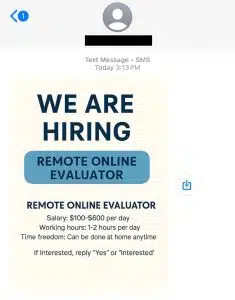
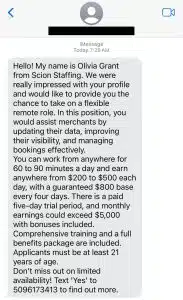
Job seekers are being contacted or finding phony job listings on job posting platforms such as Indeed, Craigslist and on social media, as well as being told they were scouted for (fake) jobs on LinkedIn. Identity criminals are asking job seekers for their ID.me login information and other sensitive personal information, such as driver’s license information and Social Security numbers (SSNs). Here are two examples of text messages that are a sign of an online job scam:
Work-From-Home Job Scams
With the shift to a hybrid work schedule (combining home and in-office work) and the increasing number of companies offering full-time work-from-home options, many people are looking to take advantage of these work-from-home perks. According to the Federal Trade Commission (FTC), in the past, scammers have taken outdated job ads from legitimate employers, modified them and posted them on employment websites.
Tips to Avoid an Online Job Scam
- Once you find a job posting, be careful how much personal information you share, at least during the application period. This is one of the most important, if not the most important, tips for consumers. Interviews by phone, Skype or Zoom are standard. However, it is a big red flag when a potential employer asks you to download a separate third-party app to communicate or if they initiate the interview through text or email. Do not turn over sensitive personal information like your SSN, financial account information or a picture of your driver’s license. Do not send your ID.me login information or log in to an ID.me account that was created for you. Numerous federal and state agencies use ID.me to verify the identities of registrants. Sharing this information or uploading information to an account set up for you allows a thief to pose as you with this login.
- Know the source of the job listing. This requires you to do some research. Look online for independent sources of information. Search the name of the company or the person who’s hiring you and add a word like “scam,” “review” or “complaint.” Searching for “Acme Co Scams” will give you search results showing whether the company is legitimate and has been associated with identity fraud. You will often see what other employees and customers think of the would-be employer. Visit the company’s official website where you’re applying and check its “Careers” or “Jobs” section to ensure they are hiring. Also, verify that you are visiting the company’s legitimate website and receiving an email from the company’s actual domain. Would-be identity thieves have gotten savvy and may replace the letter “l” with the number “1” or add something simple like a “-us” to the end of a website or email address to make it look like you are visiting a company’s legitimate website or receiving an email from a legitimate company. You can always call the company directly from the number on their official website to ensure they are hiring.
- If it seems too good to be true, it probably is. Be cautious of unsolicited texts and emails offering employment opportunities. Also, check the email address. It is a good idea to research what legitimate companies are paying for the position you are applying for, which will give you an idea of whether it is a legitimate online job opportunity or a scam. Offers for a wage or salary above industry standards are one way scammers attempt to lure in victims with an online job scam.
- Legitimate jobs don’t usually require any upfront fees or costs. Even items like company uniforms or specialized equipment, such as steel-toed shoes, are often deducted from the first paycheck or purchased by the employee through an outside company. Typically, a form of payment is not requested. If an employer requests a finder’s fee, administrative fee, background check fee or other funds, it is likely a scam. Even for legitimate actions like presenting a bank account number and routing number for direct depositing of paychecks, it’s vital to ensure the company is legitimate and the job has already been awarded before submitting the information. Also, don’t pay for the promise of a job. Only scammers will ask you to pay to get a job.
- Don’t send money to your new boss. If a potential employer or new boss sends you a check, asks you to deposit it and then buy something else with those funds, such as gift cards, it is an online job scam. Although the check may appear to have cleared and the funds seem available in your account, the check is still counterfeit, and you will be responsible for any purchases made with it.
Contact the ITRC
There are many different job scams, particularly online job scams. If you have questions, want to learn more, or believe you were the victim of an online job scam, contact us. You can speak with an expert advisor by phone or text (888.400.5530), as well as live chat. Just visit www.idtheftcenter.org to get started.
The post was originally published on 6/30/21 and was updated on 9/26/25